01 — The headline
77 days became 1.5
Closing a completed field job used to take 77 days of paperwork, phone calls, and handoffs. After the platform rolled out, the same close takes about 1.5 days. The gap between those two bars is where $10M+ in lifecycle savings lives.
02 — Situation
Work that finished in the field, but not on paper
Field crews were completing jobs on time. The record of that work wasn't keeping up: status lived on printed packets, in phone calls, and in whoever happened to know. By the time a job was formally closed, 77 days had passed, and every one of those days carried compliance exposure, delayed downstream work, and cost.
The mandate was the fuzzy kind: "modernize field workflows." The actual job was narrower and harder: find where the close process really lost its time, and rebuild it as something crews would adopt on their own.
03 — Constraints
What made it hard
Operations couldn't pause.The workflow being replaced was live infrastructure work. Every rollout step had to run alongside the old process, not instead of it.
Multiple states, multiple rulebooks.Compliance requirements varied by jurisdiction, so "one platform" had to mean one platform that behaved correctly in each state, not one lowest common denominator.
A vendor ecosystem, not one team.Contractor crews and internal crews worked the same jobs with different tools and incentives. Adoption had to work for both.
The users carry ladders, not laptops.Anything that slowed a crew down in the field would be worked around, and workarounds would quietly rebuild the paper process.
Connectivity is intermittent, not optional.Rural feeders, basements, and storm restoration do not guarantee signal. The platform had to work offline by default—queued submissions, honest sync state, recovery on reconnect—without weakening regulated asset identifiers.
04 — Key decisions
The calls that shaped it
Every program has a handful of decisions that determined the outcome more than the roadmap did. These were them.
Build around the map, not the form
The callMake the geospatial view the primary surface for supervisors and dispatch, with job status attached to locations rather than buried in lists.
The tradeoffSlower to build than a form-first tool, but it matched how field leaders already thought about their day, which is what earned daily use.
Sequence rollout by crew workflow, not by org chart
The callExpand along complete end-to-end workflows so every pilot group could actually finish work in the new system, rather than lighting up departments one at a time.
The tradeoffMessier stakeholder map early on, but no group was ever stranded half-in, half-out of the old process.
Treat state compliance as configuration, not custom builds
The callOne platform with jurisdiction-aware behavior, so each state's rules were data the system enforced rather than forks the team maintained.
The tradeoffHeavier upfront modeling with compliance stakeholders, in exchange for rollouts that didn't restart the engineering clock per state.
Design offline-first, not online-with-fallback
The callLet crews claim jobs, capture poles and packets, and queue submissions locally—surfacing connectivity and enterprise auth state honestly instead of blocking on spinners.
The tradeoffMore engineering upfront for sync, conflict handling, and ID discipline—but the alternative was crews reverting to paper the first time signal dropped.
05 — What shipped
One platform, replacing paper and phone
The platform gave crews, supervisors, and dispatch a single geospatial picture of the work: jobs on a map, structured status instead of phone calls, and a close process that happened where the work happened. On iPad, offline-first queues meant crews could keep executing when signal or Zscaler auth failed—then sync when connectivity returned. Printed packets and callback loops went away because the platform was faster than they were, not because a memo said so.
Adoption wasn't a change-management campaign. It was a product requirement: be faster than the workaround—even in a dead zone.
06 — Field reality
Offline-first, not offline-tolerant
Storm restoration and rural feeders do not wait for LTE. OMW surfaced connectivity and enterprise auth state honestly, let crews keep working locally, and synced queued submissions when the network came back—without relaxing the identifier discipline finance and compliance required.
07 — Results
Numbers attached
Beyond the headline: one compliant platform across states and vendors, close records that hold up to audit, and downstream teams working from status that's hours old instead of months old.
08 — For the next PM
What I'd tell whoever runs the next one
Instrument the baseline before you touch anything.The 77-day number did more stakeholder alignment than any deck. You can't show a collapse without measuring the "before" while it still exists.
Field adoption is won in seconds, not features.Every interaction that's slower than the old way is a vote to go back. Speed in the crew's hands was the real adoption strategy.
Make compliance a first-class product surface.Treating regulatory variance as configuration turned the scariest constraint into the platform's most durable moat.
Offline is architecture, not a loading state.Crews in dead zones will paper over a fragile online app. Queued work, visible sync state, and local-first flows were what kept adoption intact when signal dropped.
List & map
Supervisors triage the same jobs in list or map—drag to compare.
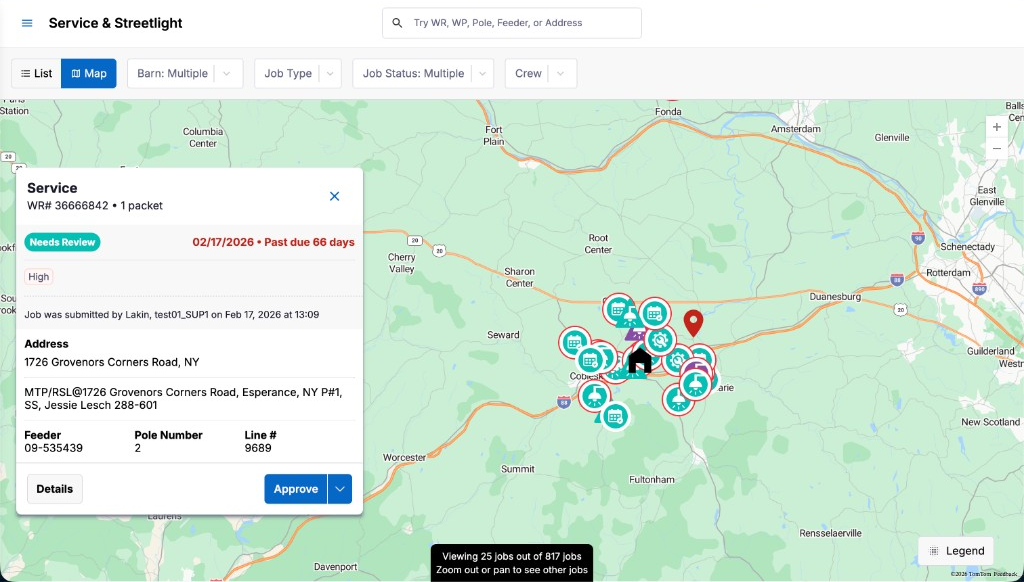
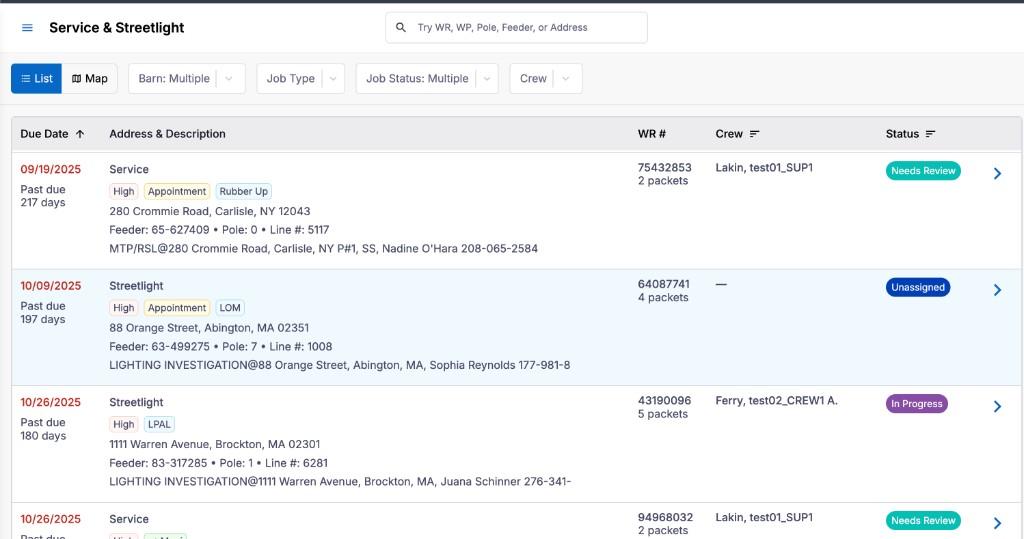
OnMyWay (OMW): geospatial field, iPad, and supervisor web
OMW: maps, offline-first crew iPad flows, pole/CWR capture, and supervisor/dispatch web. PWAs from one monorepo; Capacitor on iPad where native mattered.
Screenshot 1 of 11